

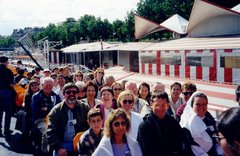

On June 25, the Washington Post published the article Seeking Answers With Field Trips in Faith (see http://www.washingtonpost.com/wp-dyn/content/article/2007/06/24/AR2007062401422.html).
This article is the latest in a string of major media and publications reporting on the tremendous growth of faith-based tourism. Some of these include my interviews with CBS Early Show, TIME Magazine, USA TODAY, The New York Times, Los Angeles Times, and dozens of other media outlets including travel, religious, and news.
One of the most interesting statistics in the article is: Todd M. Johnson, director of the Center for the Study of Global Christianity at Gordon-Conwell Theological Seminary in Massachusetts, said 7 percent of the world's Christians -- about 150 million people -- are "on the move as pilgrims" each year.
The above statistic is especially interesting when compared against the World Tourism Organization's estimation that 300 to 300 million people embark on religious travel annually (all faiths).
Speaking of statistics - the article's author Mary Jordan did a good job of citing other key statistics as well, including the growth of other pilgrimages and religious travel sites. Another finer point of Mary's article was referencing how faith based travel has affected the local economy and how one travel company grew in four years to its present-day 10,000 pilgrim travelers. Many people forget that tourism (the world's 2nd largest economy - only behind oil), and religious tourism more specifically, does act as a vessel in enriching the lives of others in the lands they visit by providing jobs, strenthening their economies, etc.
It is for the above reasons as well as those cited in the Washington Post article, that the World Religious Travel Association (WRTA) was launched last January. In short, there was a great need and demand for a global network for faith tourism companies and travelers. Next month WRTA will launch registrations for the World Religious Travel Expo which will be held in fall 2008. The primary purpose of the conference is to provide a world-class forum for networking opportunities and educational seminars for both the trade and consumer. For more information visit http://www.religioustravelassociation.com/.
June 26, 2007
June 16, 2007
WRTA officers meet Bahamas Minister of Tourism
 On June 5, the executive officers of the World Religious Travel Association (http://www.religioustravelassociation.com/) met with the newly-appointed Bahamas Minster of Tourism Neko Grant. We presented him and Linville Johnson (Deputy Director - Religious Market) plaques regarding their Charter Membership within the World Religious Travel Association.
The Bahamas are one of the countries most successfully seeking to attract and increase faith-based visitors whether via conventions, conferences, leisure vacation, retreats, missionary travel, pilgrimage, or the like.
Photo from left to right: Honnie Korngold - Vice President WRTA; President Christian Travel Finder, * Neko Grant - Bahamas Minister of Tourism, * Kevin J. Wright - Executive Director WRTA; President Religious Market Consulting Group, * Katheirne Rojas Cardona - Director of Membership WRTA, * Linville Johnson - Deputy Director Bahamas Tourist Office


Christian cruise charter of 2,700 guests

I just returned from a full-ship Christian cruise charter of 2,700 guests! Christian Travel Finder (http://www.christiantravelfinder.com/) hosted the trip. Today more than a dozen Christian full-ship cruise charters take place each year. It is one of the fastest growing and most robust segments of faith-based tourism worldwide. For more info visit http://www.christiantravelfinder.com/praisefest.html
Atlanta hot for holy meetings
Atlanta is becoming a "hot" destination for religious conventions and conferneces. To see the full article visit http://www.travelmole.com/stories/1118650.php?mpnlog=1
International Museum of the Reformation wins major award
The International Museum of the Reformation wins the Council of Europe's Museum of the Year award. To read the full article(s) visit:
http://www.unhcr.org/cgi-bin/texis/vtx/news/opendoc.htm?tbl=NEWS&id=466975134
http://www.musee-reforme.ch/index-e.php
P.S. Kevin J. Wright has joined Technorati Profile & My Space http://www.myspace.com/kevinjwright
http://www.unhcr.org/cgi-bin/texis/vtx/news/opendoc.htm?tbl=NEWS&id=466975134
http://www.musee-reforme.ch/index-e.php
P.S. Kevin J. Wright has joined Technorati Profile & My Space http://www.myspace.com/kevinjwright
Spirit of Niagara Tours (Niagara Gazette)
Spirit of Niagara Tours hopes to attract more religious groups to its cruises, especially with its faith-based heritage. Read it at: http://www.niagara-gazette.com/local/local_story_159193837.html
Launch of new Christian attractions
In the past 30 days, several new Christian attractions were launched. The future is expected to bring many more Christian and faith-based attractions. Here are the three attractions recently launched:
* Billy Graham Library www.bgea.com/BGLibrary_Index.asp
* Creation Museum (Petersburg, Kentucky) www.creationmuseum.com
* Big Valley Creation Science Museum (Alberta, Canada) www.bvcsm.com
* Billy Graham Library www.bgea.com/BGLibrary_Index.asp
* Creation Museum (Petersburg, Kentucky) www.creationmuseum.com
* Big Valley Creation Science Museum (Alberta, Canada) www.bvcsm.com
Selcuk, Turkey: Capital of Faith Tourism
http://www.sundayszaman.com/sunday/detaylar.do?load=detay&link=1143
TURKEY FAITH TOURISM
Selçuk: capital of faith tourism
Turkey continues to raise the bar for its tourism industry, a prime contributor to the nation's economy. Turkey, with its historical, natural and cultural treasures, has phenomenal tourism potential, offering opportunities often not found anywhere else in the world in terms of tours, sightseeing, entertainment and relaxation.
An average of 20 million tourists visit Turkey each year, with the "tourist paradises" of Antalya, Alanya, Marmaris, Didim, Bodrum, Kuşadası and Çeşme attracting a good portion of this number. Two new trends in tourism, though, may shift the balance. Faith tourism and nature tourism are growing in popularity, drawing new visitors and highlighting new places.
Where faith tourism is concerned, spots like the Hagia Sophia, the Sümela Monastary, Mt. Nemrut, Balıklı Lake, Cappadocia, Ephesus and of course the Meryam Ana Evi, or House of the Virgin Mary, which Pope Benedict XVI visited during his trip to Turkey, on Nov. 29, 2006, are popular draws. The House of the Virgin Mary, located near Ephesus in Selçuk, is considered by Christians all over the world to be a holy spot and is visited by more than half a million people every year.
Well-known visitors to the House of the Virgin Mary over the years have included Pope Paul XI, Pope John Paul II, former US President Bill Clinton, Sting, Brian Adams, Elton John and James Brown. Of course, another significant treasure nearby in Selçuk are the ruins of the ancient city of Ephesus. Ephesus, which is estimated by archeologists to date back to 6,000 B.C., is visited by around 1.5 million tourists every year.
Near to all of this is Turkey's third largest city, İzmir, also known as the "pearl of the Aegean." In addition to the historical points of interest in İzmir city center itself, the nearby spots of places like Çeşme, Foca, Bergama and Selçuk make the entire region a magnet for tourists. The relatively small city of Selçuk, with its population of around 25,000, lies only 75 kilometers from İzmir's city center and offers countless treasures. The town also boasts the İsa Bey Mosque, an important example of Selçuk Turk architecture. What's more, transportation to Selçuk couldn't be easier; visitors can reach it by sea, air, road or train.
As a result a significant portion of Selçuk's economy is based on profits from tourism. This income is supplemented by agriculture and animal husbandry, important ways of life for the people in the region thanks to the fertile soil.
In terms of figures Selçuk's recent popularity from Pope Benedict XVI's visit wound up raising the number of tourists coming to the region at the end of 2006 to 1.6 million. Visitors stopping at the House of the Virgin Mary were in 2004 calculated to have been 462,000, in 2005 517,000 and 650,000 in 2006.
Plans to further expand the already lively tourism industry in the region are at hand. Selçuk Mayor Vefa Ulgur talks about the plans to build three golf courses in the Selçuk district of Pamucak, which lies on the coast. Mayor Ulgur notes that while the city of Selçuk currently has a bed capacity of 11,000, there are immediate plans to expand this capacity up to 30,000.
A quick glance back at the basic history woven into the fabric of Selçuk is as follows: It was around 6,000 B.C. that the ancient city of Ephesus was founded near the Aegean gulf into which the waters of the river Menderes (Meander) flows. The soil in this area was prime for agriculture, and the position on the sea meant Ephesus would become an important trading and shipping post. The city was also a significant religious center in both pre-Christian times and the early years of Christianity. Ephesus brought forward such well known names in the religious and artistic world at the time as Artemidorus the dream-diviner, the poets Callinos and Hipponax, the philosopher Herakleitos, and the artist Parrhasius. The history of Ephesus, though, as mentioned before, actually stretches much further back, a fact that findings at the burial mounds at Arvalya and Cukurici have confirmed. Archaeological digs at Ayasuluk Hill have revealed that the region in which Ephesus is located was in fact populated from the Bronze Age through the Hellenistic Age, without interruption. It has also been confirmed that the city of "Apasas" mentioned in Hittite texts was in fact a reference to the original city of Ephesus, which was located on Ayasuluk Hill.
The Ephesus that tourists now visit was built by one of Alexander the Great's generals, Lysimakos, in the year 300 B.C. The building of the magnificent walls, theaters and agora which can be toured even today was the start of this city. Ephesus experienced one of the heights of glory during the second century. In part due to its well-used port, Ephesian trade began to increase, and the city became very wealthy. During the reigns of Emperors Trajan and Hadrian, giant architectural projects took hold in the city, and the number of theater seats alone in the city rose to 24,000. Estimates are that the population of Ephesus around this time was near to 250,000. At the start of the 13th century, the region fell under the control of the Turkish Aydinogullari rule. It was during this period that the largest mosque of the time was built by Isa Bey; the mosque bearing his name was built in Selçuk in 1375. In 1426, Ayasuluk was added to the rest of the growing Ottoman lands and in 1912, Ayasuluk's name was changed to Selçuk, officially becoming a province connected to İzmir in 1957.
According to Christian belief, shortly before he was crucified, Jesus Christ entrusted the care of his mother, Mary, to his friend and one of his disciples, St. John. According to some accounts, after Christ's crucifixion, St. John, believing it was not safe for Mary to remain in Jerusalem, took her with him to stay on top of Mt. Bülbül (Mt. Koressos) just above Ephesus. Over time, the exact location of this place, one that many believe to be the spot where the Virgin Mary spent the last days of her life, was forgotten. The house was rediscovered after the Middle Ages and became the subject of widespread debate. This went on until statements made by a German woman, Katherine Emmerich, who was bedridden and had never left her country, claiming she knew where the Virgin Mary's house had been. Then, in 1891, Eugene Poulin, the director of an İzmir school and a Lazarist priest, commissioned a group of people to look into how true the statements made by Emmerich might be. The group searched around the mountains to the south of Ephesus and, in the end, came upon a small house referred to by locals as the "Panaya Kapulu." This small house fit the description provided by Emmerich perfectly. After further research, the then archbishop in İzmir, Archbishop Timoni, gave permission for a religious ceremony to take place at the house. Later, in 1961, Pope John XXIII put an end to the debates swirling around the House of the Virgin Mary, declaring it an official point of pilgrimage for believers. The visits made by Pope Paul VI in 1967 and Pope John Paul II in 1979 also served to underscore the significance of the spot. Now every year on Aug. 15, the day that Christians believe the Virgin Mary fell into eternal sleep (referred to as the "dormission"), there is a special Mass that takes place at the house. Many people come for these religious services.
Camel wrestling festivals, which happen in no other country in the world, take place every year on the third Sunday of January in Selçuk. This year's 25th Selçuk-Ephesus Camel Wrestling Festival occurred on Jan. 21, 2007, and attracted much local and foreign attention. The day before the actual camel wrestling occurs, promotion, parades and all sorts of entertainment work to build local excitement. The wrestling begins on Sunday at 10 a.m. and finishes later that day. Another important festival in Selçuk is the Selçuk-Ephesus Culture, Arts and Tourism Festival. This is a festival which has been occurring since 1962, always during the first week of May.
What to eat and where to eat in Selçuk
You can find all sorts of examples of food specialties peculiar to Selçuk when you visit this city. The Aegean region, where Selçuk is located, is famous for its fish dishes (like sea bass and grey mullet) and its seafood in general. Selçuk is also known for dishes that use local herbs and vegetables unique to the region (such as mallow and arapsaci). The local fruit is also famous - fruit such as peaches, apples and watermelons can be picked fresh off the branch year round. Meat dishes like köfte and shish kepab have also become symbols of Selçuk cuisine. A popular stop-off point for Selçuk visitors is the Selçuk Köftecisi, featuring the köftes and other grilled meats that have become synonymous with eating in Selçuk. Follow your dinner here with the famous Artemis dessert, a milk-based treat found only in Selçuk. Another place to be sure not to miss is the outdoor restaurant Askeri Yeri, a stop-off point for visitors touring the Yedi Uyuyanlar Cave. Here, you won't be able to get enough of the delicious varieties of gözleme (a Turkish version of crepe or pancake filled cheese, ground beef, parsley and other herbs or even chocolate). How to get thereYou can reach Selçuk, situated only 75 kilometers from İzmir, by air, land, sea or rail. For those wanting to save time, flights into İzmir's Adnan Menderes Airport will have you in Selçuk quickly, as this airport is only 60 kilometers from Selçuk. Tourists choosing to come in by boat have two choices. Boats docking at the İzmir's Port of Alsancak have only an hour of road travel to reach Selçuk. Boats docking at Kuşadası are even closer, traveling only 25 minutes to get to Selçuk. Where to stayThere are a number of hotels and pensions dotting Selçuk, so much so that the small city already boasts an 11,000-bed capacity. Also, located nine kilometers from Selçuk is the town of Pamucak, which has many four- and five-star hotels of its own. For those who want to stay far from the city and closer to nature, the village of Şirince is an ideal option, only seven kilometers from Selçuk.
03.06.2007
Travel
ÖZDEMİR ÖZKAN
June 2, 2007
Voluntourism is new trend for American vacationers
CULTURAL DIGEST: 'Voluntourism' a new trend for American vacationers; ...
by Erin Roach
NASHVILLE, Tenn. (BP)--More Americans are opting to spend their vacation time participating in what Christians have known for years as mission work -- building houses and schools or visiting orphanages.The new term for this trend is "voluntourism," and some say it was spurred by the tragedies of 9/11, the Southeast Asia tsunami and Hurricane Katrina. College students are choosing charitable or humanitarian work over a week at the beach during spring break, the Associated Press reported, and baby boomers with money to spend and time to donate also are fueling the trend."Immersion with volunteerism is so much more than you could get by sitting on a beach or on a tour bus," Sally Brown of Ambassadors for Children told AP, adding that the number of travel organizations that offer voluntourism trips has probably doubled in the past three years.The nonprofit Ambassadors for Children lets participants mix purpose with pleasure by boarding them at a four-star hotel in Puerto Vallarta, Mexico, and allowing them to spend three of the eight days visiting an orphanage, library and preschool, AP said.Mike Wood spent a recent vacation in Honduras, building latrines and pig pens in a village without electricity, running water or cell phone reception, AP said. He spent the days digging holes, pouring cement and cutting wood, and he managed to sneak in some visits to nearby Mayan ruins."It's hard work, but there's nothing to worry about," Wood, a history teacher, told AP. "No one can get ahold of you so you're not worrying about the stock market or worrying about family too much. There's no communication so it's a very nice break from the pressures of the job."Some participants told AP that voluntourism is more draining than traditional vacations but much more rewarding. "To see the people's faces -- they were so happy we were helping them. That's something you don't forget," said Peggy Fuller, a North Carolina dermatologist who used her sabbatical to build houses in Sri Lanka.Others spend their time working as mentors to disadvantaged youth, tutoring and learning how the less fortunate of the world live, AP reported March 29."You feel that you're helping people and you're also getting to learn about a different culture, whether it's West Virginia or Tanzania," Alyssa Stahl, a Chicago banker, said.
May 19, 2007
Christian Today article (Australia)
Faith-Based Travel Market Valued At $18 Billion
By: Joshua Chan Christian Today Correspondent
http://au.christiantoday.com/article/faith-based-travel-market-valued-at-18-billion/2716.htm
The World Religious Travel Association (WRTA) estimates that the faith based travel market is worth $18 billion. Last year WRTA came into existence through the formation of an association for faith-based travel agencies. Their existence came about due to an increase demand for faith-based vacations. Their mission is simple and clear. Kevin Wright, the director for WRTA, said: “We will advise, and assist the travel industry in working with the religious market and establish faith based vacations as a key travel option for the religious consumer.” The World Tourism Organization reported that faith-based travel is one of the fastest growing segments of the industry; with numerous surveys indicating that one-quarter of travellers said they were currently interested in taking a spiritual vacation (e.g. religious retreat, or pilgrimage) and that the appeal of a spiritual vacation spans all age groups.The World Travel Market, based in London, recently said that faith-based travel was one of the top critical issues and trends facing the travel and tourism industry in the 21st century. Zealandier Tours of New Zealand became the first Christian based tour company to service New Zealand customers in Easter 2006
Subscribe to:
Posts (Atom)